

Jio Platforms IPO. Decoded.
India's largest mobile operator, 533 million customers strong, comes to market with a 100% fresh issue of ₹30,213 crore. Most of the money retires debt. Every number below carries its source, so you can check it yourself.
 Opens 21 Oct 2026
Price band
₹1,065 – 1,119
Lot
12 shares
Issue
₹30,213 cr
Fresh · OFS
100% · nil
Anchor
19 Oct
Open · close
21 – 23 Oct
Listing
28 Oct
Registrar
KFin
Figures in ₹ crore unless stated · FY = year to 31 March · data as of 14 October 2026 · edition 3.0
- Cap price
- ₹1,119
- Band ₹1,065–1,119 · lot 12 · ₹13,428 minimum
- Issue size
- ₹30,213 cr
- 100% fresh · no offer for sale
- Market cap
- ₹10.3 L cr
- ₹10,30,491 cr at the cap, post-issue
- FY26 P/E
- 34.3x
- EV/EBITDA 14.8x · Airtel 40.7x and 10.6x
This is a deleveraging IPO. About 91% of the money repays debt, so the benefit shows up as lower interest cost, not as new capacity.
The whole case on one page
Issue size (at ₹1,119)
₹30,213 cr
27 crore new shares · no OFS
Market cap post-issue
₹10.30 lakh cr
₹9.81 lakh cr at ₹1,065
P/E on FY26 profit
34.3x
Bharti Airtel about 40.7x (RHP, 13 Oct close)
EV / EBITDA, FY26
14.8x
Bharti Airtel about 10.6x
Minimum investment
₹13,428
1 lot of 12 shares at the cap
Grey market premium
₹200
about 18% · unofficial · 14 Oct close
Five things to know
- 01
A scale leader that has turned cash generative.
533.3 million customers, 49.78% of India's wireless broadband users, and ₹42,071 crore of EBITDA left after capex in FY26 against ₹1,449 crore in FY24. In the June 2026 quarter, 80% of EBITDA survived capex.
- 02
A deleveraging IPO, not a growth raise.
The whole ₹30,213 crore is fresh money. ₹27,500 crore (91%) prepays three foreign-currency loans of Reliance Jio Infocomm that cost 1.40–5.13% before hedging. The ₹1,04,514 crore of spectrum dues to the government, at 7.2–7.3%, are untouched.
- 03
Cheaper on P/E, dearer on EV/EBITDA.
34.3x FY26 earnings is about 16% below Bharti Airtel's 40.7x. But 14.8x EV/EBITDA is about 40% above Airtel's 10.6x, and the second measure is the one telecom investors use because it ignores the tax shield and depreciation choices that flatter Jio's profit line.
- 04
The price assumes growth, and ARPU is the lever.
To trade at Airtel's EV/EBITDA, Jio's EBITDA must reach about ₹1,06,000 crore, 2.4 years away at the recent 15% pace. Airtel's India mobile ARPU is ₹263.9; Jio's is ₹215.6. Every ₹1 of ARPU across the base is about ₹640 crore of yearly revenue.
- 05
You are buying a company inside a group.
Reliance Retail is the sole distributor of prepaid, which is 77% of revenue. The 'Jio' brand is licensed royalty-free from Reliance Industries, which can end the licence if it loses control. Related-party expenses were 9.34% of revenue in FY26. The RHP lists 65 risk factors; group dependence is the second.
Evidence for
• PAT grew at 18.4% a year FY24–26; EBITDA margin rose to a record 53.3% in the June 2026 quarter.• Cash capex fell from 48.8% of revenue (FY24) to 23.3% (FY26) and 10.7% in Q1 FY27 as the 5G build finished.• Leader in every growth pocket: 49.78% of wireless broadband, 78.62% of 5G fixed-wireless homes, 61.73% of fixed-broadband net adds in Q1 FY27.• AAA-rated subsidiary, no auditor qualification in three years, contingent liabilities only 0.43% of net worth.
Evidence against
• Return on average capital employed fell from 12.83% to 10.76%; return on net worth is 9.42% against Airtel's 20.32%.• Finance cost rose 76% in FY26 to ₹8,653 crore and was ₹2,980 crore in Q1 FY27 alone, because 5G interest stopped being capitalised.• ₹67,955 million (₹6,796 crore) of GST input-credit demands sit outside the contingent-liability line; the ₹1,389 crore spectrum-charge dispute is at the Supreme Court with no stay.• 77% of revenue through one group distributor; brand owned by the promoter; current tax is near zero only while past losses last.
What would change our mind: the analyst states one falsifiable line at sign-off, for example an ARPU or tariff level, or a Q2 FY27 finance-cost print. Until then this page carries evidence, not a verdict.
What Jio actually does
Jio Platforms Ltd (JPL), incorporated in November 2019, is the digital and telecom holding company of Reliance Industries. Its one material subsidiary, Reliance Jio Infocomm Ltd (RJIL), holds the licence and all spectrum and earns 88% of revenue and 94% of profit. Around it sit 13 other Indian and 19 foreign subsidiaries and one joint venture. The company reports a single segment.
Customers (30 Jun 2026)
533.3 mn
539.2 mn by 31 Aug · +8.9 mn in Q1
5G customers
284.9 mn
53% of base · 3rd largest base globally
Home broadband
28.6 mn
+43% in a year · 14.0 mn on AirFiber
ARPU, Q1 FY27
₹215.6
per user per month, exit quarter
Wireless broadband share
49.78%
30 Jun 2026 · No. 1 (TRAI via RHP)
Employees
27,932
+63,795 contract staff · 30 Jun 2026
Exhibit 1
The Jio story, 2016 to 2026
From the RHP's own milestone table (p.249–250) and company releases
2016
4G launch, 5 September
India's first greenfield all-IP 4G network with VoLTE.
2017
100 million in under 180 days
JioPhone launched; 42.67% share of India's broadband customers by September.
2019
JioFiber, and JPL is formed
Fibre and tower assets demerged into Jio Digital Fibre and Reliance Jio Infratel (now Summit Digitel). JPL incorporated 15 Nov; RJIL becomes its wholly owned subsidiary 13 Dec.
2020
₹1,52,055 crore from 13 investors
Meta, Google, Silver Lake, Vista, General Atlantic, KKR, Mubadala, ADIA, TPG, L Catterton, PIF, Intel and Qualcomm buy about 33% in one year. ₹1,04,365 crore of RJIL liabilities move to RIL.
2021
JioPhone Next
An affordable smartphone on Pragati OS, built with Google.
2022
5G spectrum in all 22 circles
700, 800, 1800, 3300 MHz and 26 GHz; India's first standalone 5G network.
2023
JioAirFiber and JioBharat
Fixed-wireless home broadband; 5G in 98% of census towns; first to 10 million fibre homes.
2024
JioAICloud
Largest fixed-wireless base outside China.
2025
500 million customers
JioPC launched; Google AI Pro bundled with Reliance Intelligence; enterprise-AI tie-up with the Reliance–Meta JV.
2026
From DRHP to IPO
Pankaj Pawar named CEO (24 Mar); Akash Ambani becomes MD (9 Apr); DRHP filed 19 Jun; RHP filed 14 Oct; issue opens 21 Oct.
RHP, History and Certain Corporate Matters, p.249–255; Capital Structure, p.100–102.
Exhibit 2
What you buy, and what you do not
Group structure after the issue
Promoter
Reliance Industries Ltd · 64.48% after the issue
The listed company
Jio Platforms Ltd
14 Indian and 19 foreign subsidiaries, 1 joint venture · standalone digital-services revenue ₹16,167 cr in FY26
| Subsidiary | Holding | What it does | FY26 revenue | FY26 PAT |
|---|---|---|---|---|
| Reliance Jio Infocomm (RJIL) | 100% | Licence, spectrum, mobile, home, enterprise | 1,28,871 | 28,173 |
| Reliance Jio Infocomm UK | 100% via RJIL | Voice and data wholesale | 1,815 | 5 |
| Reliance Jio Infocomm Pte (Singapore) | 100% via RJIL | International connectivity, roaming | 1,568 | 373 |
| Radisys Corporation (USA) | 100% | Open telecom software; owns Mimosa (FWA radios) | 1,281 | 31 |
| Radisys India | 100% | Software development | 868 | 66 |
| Jio Things | 100% | Enterprise IoT, CPaaS, M2M | 801 | 5 |
| Saavn Media (JioSaavn) | 88.15% | Music streaming; ₹1,132 cr accumulated losses | 344 | −54 |
| Jio Haptik Technologies | 100% | Conversational AI | 309 | 37 |
| Accops Systems | 80.81% | Network security, remote access | 104 | 8 |
| Jio Satellite Communications | 100% | Satellite licence (GMPCS, VSAT) to 2042 | 34 | 5 |
| Reverie Language Technologies | 84.56% | Indian-language tech | 5 | −7 |
| Indiavidual Learning (Embibe) | 100% | AI learning platform | 0 | −0 |
| Jio Space Technology | 51% JV with SES | Satellite broadband | — | — |
RHP, The Subsidiaries and Joint Venture, p.256–292. JioStar / JioHotstar (an RIL media company) · Jio Financial Services (separately listed) · Reliance Retail and JioMart · Reliance Intelligence and the Reliance–Meta enterprise-AI JV · the Jamnagar AI data centre. These share the 'Jio' name but sit outside JPL.
How a rupee is earned
Prepaid mobile is the engine: 77.08% of FY26 revenue, all sold through Reliance Retail as sole distributor. Home broadband is the fastest-growing line at 28.6 million homes, up 43% in a year. Enterprise serves over 90% of India's banks. Digital services (MyJio with 227.6 million monthly users, JioSaavn, JioAICloud, JioPC, JioGames) ride on top. Revenue = customers × ARPU: each ₹1 of ARPU across 533.3 million users is about ₹640 crore a year.
Exhibit 3
Ten years of customers and ARPU
Customers in million (bars) · ARPU in ₹ per month, exit quarter (line)
FY24 onward from the RHP KPI table (p.131); FY18–FY23 from press reports of company results (secondary). The FY22 dip follows SIM consolidation after the 2021 tariff round.
Exhibit 4
Nine quarters, four engines
Q1 FY25 to Q1 FY27 · customers, ARPU, 5G users and data per user
Customers (mn)
ARPU (₹ per month)
5G users (mn)
Data per user (GB a month)
RIL quarterly results releases (Jul 2024 – Jul 2026); Q1 FY27 and FY26 exit values match the RHP.
Exhibit 5
Home broadband: the new leader
India's fixed-broadband customers, million, 30 Jun 2026
TRAI data as cited in the RHP (Analysys Mason, commissioned by the issuer), p.169–170. Jio took 61.73% of net adds in Q1 FY27.
Exhibit 6
The network edge
Average mobile download speed, Mbps, Q3 FY26
Opensignal, as cited in the RHP p.164–165. Rivals are unnamed in the report.
Spectrum
26,800.8 MHz
about 15.8 years average life left; majority to 2041–42
Towers used
3,60,537
1,74,451 owned by Summit Digitel (30-year MSA)
Fibre
1.0 mn+ route km
about 98% supplied by Jio Digital Fibre (30-year agreement)
Patents
7,220 filed
1,043 granted · only Indian company in WIPO PCT top 20 (2025)
Exhibit 7
Who works at Jio
27,932 full-time employees by function, 30 Jun 2026
RHP p.231. Headcount fell 22% from 35,757 (Mar 2024) while revenue rose 34%; attrition was 21.78% in FY26. Field and installation work sits with 63,795 contract staff and freelance associates.
So what: Jio is a utility-like subscription business at national scale with a real technology stack behind it. Growth comes from three levers: more homes on broadband, more users on 5G, and higher ARPU.
The promoter, the board and the people who run it
The promoter is Reliance Industries, listed on the BSE since 1978, 50.48% held by the Ambani family and its entities. Four Ambanis sit on the Jio Platforms board. Every photograph here is a licensed image; the facts are from the RHP's management and promoter chapters (p.293–318).
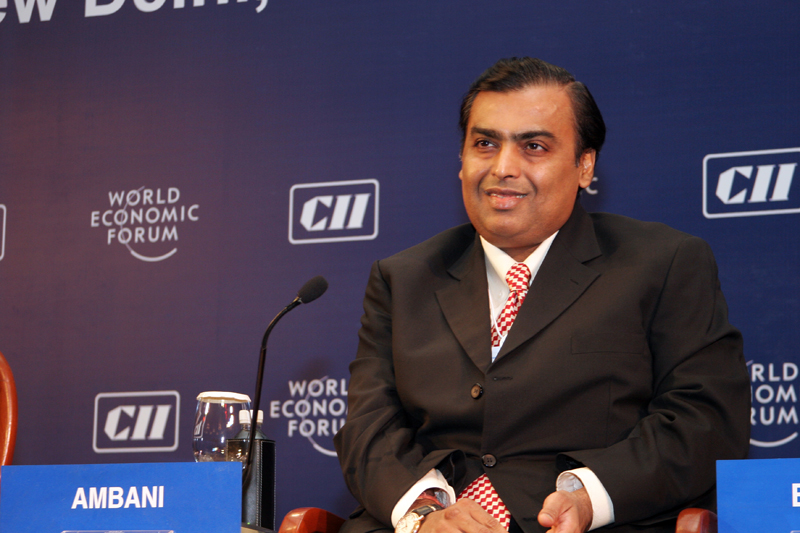
Mukesh D. Ambani
Chairman · promoter of RIL
Chairman and MD of Reliance Industries; on its board since 1977.
Founded Reliance Retail and Jio. Non-executive chairman of JPL since July 2020; FY26 sitting fees ₹5 lakh.
RIL holds 66.43% of Jio Platforms at an average cost of ₹89.58 a share; the IPO price is 12.5 times that.
Photo: World Economic Forum, 2007 · CC BY-SA 2.0 via Wikimedia Commons

Akash M. Ambani
Managing Director · 9 Apr 2026 to 8 Apr 2031
Age 34; economics, Brown University. On the JPL board since incorporation; chairman of RJIL.
Leads the 4G-to-5G-to-AI roadmap. TIME100 Next (2022).
FY26 remuneration ₹10.8 crore within a ₹10–20 crore band; holds no shares.
Photo: Prime Minister's Office (India), 2023 · GODL-India via Wikimedia Commons
Exhibit 8
The board
Ten directors, five independent · RHP p.293–300
| Director | Age | Role | Since | Background |
|---|---|---|---|---|
| Mukesh D. Ambani | 69 | Chairman, non-executive (RIL nominee) | Jul 2020 | Chairman and MD of Reliance Industries; on its board since 1977; founded Reliance Retail and Jio. Chemical engineering, ICT Mumbai. |
| Akash M. Ambani | 34 | Managing Director | Nov 2019 · MD 9 Apr 2026 to 8 Apr 2031 | Leads the 4G-to-5G-to-AI roadmap; chairman of RJIL; economics, Brown University. FY26 pay ₹10.8 crore. |
| Isha M. Ambani | 34 | Non-executive director | Nov 2019 | Runs Reliance Retail Ventures; director of Jio Financial Services and RIL. Yale, Stanford MBA. |
| Anant M. Ambani | 31 | Non-executive director | Mar 2020 | Executive director of RIL; leads the new-energy transition. Brown University. |
| Manoj H. Modi | 69 | Non-executive director | Jul 2020 | With RIL since 1980; conceptualised the Jio and Reliance Retail strategies; now leads RIL's AI and new-energy entry. |
| Raminder Singh Gujral | 72 | Independent · chairs Audit Committee | Jul 2020 | Former Finance Secretary, Government of India; also on the RJIL board. |
| Dr Shumeet Banerji | 66 | Independent · chairs NRC, Risk, CSR | Jul 2020 | Former CEO of Booz & Company; independent director of RIL and Reliance Retail. |
| Haigreve Khaitan | 56 | Independent | Jul 2020 | Senior partner, Khaitan & Co; boards of RIL, Grasim, Tech Mahindra, Dalmia Bharat. |
| Dinesh H. Kanabar | 68 | Independent | Jul 2020 | Founder of Dhruva Advisors; boards of RIL, Adani Green, INOX Air Products. |
| Zia J. Mody | 70 | Independent | 25 Mar 2026 | Co-founder of AZB & Partners; former SEBI corporate-governance committee member. |
Scroll sideways
Joint auditors: Deloitte Haskins & Sells LLP and Chaturvedi & Shah LLP, unchanged for five years. Audit Committee chaired by R.S. Gujral, former Finance Secretary.
Exhibit 9
Who runs Jio day to day
Key managerial personnel and senior management, per the RHP p.308–312
Pankaj Mohan Pawar · 54
Chief Executive Officer
Since 24 Mar 2026; also MD of RJIL; with Reliance since 2000. FY26 pay ₹8.2 cr. Holds 90,000 shares.
Mathew Oommen · 58
Group President
Owns the technology vision and the 5G stack; GSMA board; with Reliance since 2011. FY26 pay ₹53.7 cr, the highest in the company. Holds 90,000 shares.
Saurabh Sancheti · 41
Chief Financial Officer
IIT Roorkee, IIM Ahmedabad; ran the 2020 ₹1.52 lakh crore raise; with Reliance since 2013. FY26 pay ₹7.1 cr.
Anshuman Thakur · 49
Chief Strategy Officer
Ex-Morgan Stanley and Rothschild; director of Jio Financial Services and JioStar. FY26 pay ₹13.5 cr.
Aayush Bhatnagar · 41
Chief Innovation Officer
5G RAN and core, JioBrain, 6G research.
Shyam Mardikar · 55
President, Autonomous Network Platform
Former CTO (wireless) of Bharti Airtel; appointed 1 Mar 2026.
Daniel Bailey · 57
President, International Business
Joined Mar 2026 from Deutsche Bank (chairman, TMT EMEA and Asia).
Pay is FY26 gross remuneration as printed. Shareholdings are from the ESOP scheme of 2020 at ₹10 exercise price; none exceeds 0.01%.
Four of the five non-independent directors are the Ambani family; the fifth, Manoj Modi, has been with RIL since 1980. Half the board is independent, which meets the listing rule but no more.
No director holds shares. Six senior managers hold 40,000–90,000 shares each (worth ₹45 lakh to ₹1 crore at the cap), all from the 2020 ESOP at ₹10 exercise price.
Three leadership changes in March 2026, weeks before the DRHP: the CEO (Kiran Thomas resigned, Pankaj Pawar appointed), the Meta and Google nominee directors (both resigned), and one independent director replaced by Zia Mody.
RIL, Meta and Google could each nominate directors under the shareholder agreements. Every such right ends on listing.
Litigation against the promoter: 3 criminal, 756 tax and 5 material civil cases totalling ₹44,187 crore plus US$4.13 billion, led by the KG-D6 gas-migration claim (US$2.81 billion, Supreme Court, part-heard). Against the company itself: eight tax cases worth ₹7.5 crore.
Who owns Jio, before and after
Fresh shares dilute every holder by 2.93%; nobody sells. The RHP lists 104 shareholders, of whom ten hold 97.32% (p.107–110).
Exhibit 10
Who owns Jio, before and after the IPO
% of equity · 893.90 crore shares before, 920.90 crore after
| Holder | Shares (cr) | Before | After |
|---|---|---|---|
| Reliance Industries (promoter) | 593.78 | 66.43% | 64.48% |
| Jaadhu Holdings (Meta) | 89.23 | 9.98% | 9.69% |
| Google International | 69.09 | 7.73% | 7.50% |
| Public Investment Fund (Saudi Arabia) | 20.69 | 2.31% | 2.25% |
| KKR (Omicron Asia Holdings II) | 20.69 | 2.31% | 2.25% |
| Vista Equity (VEPF VII AIV I) | 20.69 | 2.31% | 2.25% |
| Silver Lake (two vehicles) | 18.57 | 2.08% | 2.02% |
| Mubadala (MIC Redwood 1) | 16.55 | 1.85% | 1.80% |
| General Atlantic | 12.01 | 1.34% | 1.30% |
| ADIA (Platinum Jasmine A 2018 Trust) | 10.35 | 1.16% | 1.12% |
| TPG (India Markets) | 8.28 | 0.93% | 0.90% |
| Intel Capital · L Catterton · Qualcomm | 8.23 | 0.93% | 0.90% |
| ESOP trust, employees, 2020 CCD holders | 5.72 | 0.64% | 0.62% |
| New IPO shareholders | 27.00 | — | 2.93% |
RHP shareholding pattern p.107–110. Post-issue = pre × 893.90 ÷ 920.90 (our arithmetic). Silver Lake combines its two vehicles; the last two rows are computed from the allotment table.
Exhibit 11
The 2020 investors, and what the IPO price means for them
From the RHP capital build-up table (p.100–102)
| Investor | Invested (₹ cr) | Price paid (₹) | Holding now | IPO price ÷ entry |
|---|---|---|---|---|
| Meta (Jaadhu Holdings) | 43,573 | 488.34 | 9.98% | 2.29x |
| 33,737 | 488.34 | 7.73% | 2.29x | |
| KKR | 11,367 | 549.31 | 2.31% | 2.04x |
| Vista Equity | 11,367 | 549.31 | 2.31% | 2.04x |
| PIF (Saudi Arabia) | 11,367 | 549.31 | 2.31% | 2.04x |
| Silver Lake (two rounds) | 10,203 | 549.31 | 2.08% | 2.04x |
| Mubadala | 9,094 | 549.31 | 1.85% | 2.04x |
| General Atlantic | 6,598 | 549.31 | 1.34% | 2.04x |
| ADIA | 5,683 | 549.31 | 1.16% | 2.04x |
| TPG | 4,547 | 549.31 | 0.93% | 2.04x |
| L Catterton · Intel · Qualcomm | 4,519 | 549.31 | 0.92% together | 2.04x |
| Reliance Industries (promoter) | 53,190 | 89.58 | 66.43% | 12.49x |
Rupee amounts = shares allotted × issue price. The 2020 round valued Jio at about ₹4.91 lakh crore; the IPO prices it at ₹10.30 lakh crore. For Meta and Google that is about 15% a year, for the July 2020 investors about 12% a year, before any dividend (none paid). None of them is selling.
Exhibit 12
The supply calendar
When locked-in shares can first be sold, counted from the expected 26 Oct allotment
| Holder | Lock-in | Earliest sale |
|---|---|---|
| Anchor investors, 50% | 30 days | about 25 Nov 2026 |
| Anchor investors, other 50% | 90 days | about 24 Jan 2027 |
| All other pre-IPO holders (Meta, Google, funds, employees) · 33.57% | 6 months | about 26 Apr 2027 |
| Promoter, holding above the 20% contribution · about 44% | 1 year | about Oct 2027 |
| Promoter's contribution · 20% of post-issue capital | 3 years | about Oct 2029 |
RHP p.104–106 prints the promoter lock-in as three years on the 20% contribution and one year on the rest, six months for all other pre-issue holders, and 30/90 days for anchors. The 2020 investors' 32.9% is the block to watch: Meta and Google alone hold 17.2% after the issue, almost six times the new public float.
So what: The promoter keeps 64.48% and loan covenants require it to stay above 51%. The free float that actually trades on day one is 2.93% of the company, about ₹30,000 crore, until the anchor and six-month locks open.
Where the ₹30,213 crore goes
Exhibit 13
Out of every ₹100 raised
One cell = ₹1 of gross proceeds at the cap
- Prepay RJIL foreign-currency loans 91.0%
- General corporate purposes and issue expenses 9.0%
RHP Objects of the Issue p.116–125: ₹27,500 crore to prepay RJIL borrowings in FY27; general corporate purposes capped at 25% of gross proceeds; issue expenses blank until the Prospectus. The remainder shown is a difference, not a disclosed figure. Monitoring agency: Crisil Ratings. No bridge loan.
Exhibit 14
The loans being prepaid
Three external commercial borrowings of RJIL, outstanding 30 Jun 2026
| Facility | Amount | ₹ cr | Maturity | Purpose |
|---|---|---|---|---|
| Term loans, 12 Jun 2023 (16 banks) | US$676 mn + ¥44,923 mn | 9,019 | 26 Jun 2028 | 5G capex |
| Term loans, 18 Nov 2022 (15 banks) | US$1,200 mn + ¥41,814 mn | 13,798 | Jun 2028 | 5G capex |
| Term loan, 23 Mar 2022 (7 banks) | US$750 mn | 7,100 | 16 Mar 2028 | 5G capex and spectrum |
RHP p.118–121. Interest 1.40% to 5.13% a year before hedging; all mature in 2028; prepayable without penalty on seven days' notice. Lenders include HDFC Bank and affiliates of BofA, BNP Paribas and SBI, which are also lead managers to this issue. The ₹27,500 crore object is less than the ₹29,917 crore outstanding, hence 'in full or in part'.
Interest the prepayment removes
₹385–1,410 cr
a year, pre-tax, at the printed 1.40–5.13% coupons before hedging costs. Our arithmetic on ₹27,500 cr.
Interest it does not touch
≈ ₹7,500 cr
a year on ₹1,04,514 cr of spectrum dues at 7.20–7.30%. Our arithmetic from RHP Note 17.
Exhibit 15
Offer structure
100% fresh issue, no offer for sale. The money goes into the company.
| Item | At ₹1,065 | At ₹1,119 |
|---|---|---|
| Fresh shares (crore) | 27.00 | 27.00 |
| Issue size (₹ cr) | 28,755 | 30,213 |
| Post-issue market cap (₹ cr) | 9,80,762 | 10,30,491 |
| Dilution | 2.93% | 2.93% |
| Shares after issue (crore) | 920.90 | 920.90 |
RHP p.72–73, 529–533; price band and lot per the 14 Oct exchange filing. Book-built under SEBI ICDR Regulation 6(1). Hyundai Motor India (2024) and LIC (2022), the two previous record issues, were entirely offers for sale.
Exhibit 16
Who gets the shares
₹ crore at ₹1,119 · reservations first, then the net issue split 50 / 15 / 35
| Category | Share | ₹ cr | Who and how |
|---|---|---|---|
| Qualified institutions (QIB) | ≤ 50% of net issue | 13,607 | Up to 60% to anchors (about ₹8,164 cr) on 19 Oct; a third of the anchor book reserved for domestic mutual funds |
| Retail individuals | ≥ 35% | 9,525 | Bids up to ₹2 lakh; at least one lot each, then proportionate |
| Non-institutional (NII) | ≥ 15% | 4,082 | One-third for ₹2–10 lakh bids (₹1,361 cr); two-thirds above ₹10 lakh (₹2,721 cr) |
| RIL shareholders | reserved | 2,500 | Individuals and HUFs holding RIL shares on 14 Oct 2026; bid up to ₹2 lakh; may also bid in retail or NII |
| Employees | reserved | 500 | JPL, RIL and subsidiary employees; ₹54 discount; bid up to ₹5 lakh, first ₹2 lakh allotted before the rest |
RHP Issue Structure p.529–533. Rupee splits are computed on the ₹27,213 crore net issue. Unsubscribed employee and RIL-shareholder portions spill to each other, then to retail and NII 70:30.
Exhibit 17
Money timeline
14 Oct
RHP filed
RIL shareholder eligibility fixed on this date
19 Oct
Anchor bidding
Final anchor list published by 20 Oct
21 Oct
Issue opens
Funds blocked in your bank account
23 Oct
Issue closes
UPI mandate must be accepted by 7 pm
26 Oct
Basis of allotment
T+3 timeline (reported)
27 Oct
Refunds and demat credit
Unblocking for unsuccessful bids
28 Oct
Listing on NSE and BSE
'On or about' per the RHP
Anchor, open, close and the 7 pm UPI cut-off are from the RHP (p.4). Allotment and refund dates follow the T+3 rule as reported by aggregators; listing is 'on or about' 28 October per the RHP (p.474).
Exhibit 18
The largest Indian IPOs
Issue size, ₹ crore
Jio at the cap is 8.5% larger than Hyundai Motor India and 47% larger than LIC. Sizes of earlier issues from their prospectuses, as reported.
So what: This is a deleveraging IPO. The loans it retires are the cheapest money on the balance sheet. The expensive line, spectrum dues at over 7%, stays. Finance cost was ₹8,653 crore in FY26 and ₹2,980 crore in Q1 FY27 alone.
A three-player market with pricing power
Jio's 2016 entry made voice free, crashed data prices and pushed most rivals out. What is left is a private duopoly (Jio and Bharti Airtel), a stressed Vodafone Idea and state-owned BSNL. Industry tariff rounds have lifted ARPU; the last was in Q2 FY25.
Exhibit 19
Out of every 100 wireless broadband users
Market share, 30 Jun 2026 · one cell = 1%
- Jio 49.8%
- Bharti Airtel 35.5%
- Vodafone Idea 12.5%
- BSNL 2.2%
TRAI data as cited in the RHP p.163–164 (includes fixed-wireless, 1.68% of the total). The top three hold over 97%.
Exhibit 20
The price of a gigabyte
Average cost to the customer, ₹ per GB, exit quarter
RHP p.157–160. Data got 96.7% cheaper; usage went from under 0.2 GB to 26.7 GB a month per user across the industry. India's ₹7.5 compares with ₹33.4 in China and ₹228.4 in the USA.
Exhibit 21
The ARPU gap
Mobile ARPU, ₹ per user per month, Q1 FY27
RHP peer table p.189–193. Vodafone Idea's figure is approximate (the printed table is garbled); Vi reports a higher 'customer ARPU' excluding M2M.
Exhibit 22
ARPU, three operators, three tariff rounds
₹ per user per month, March quarter of each year · markers show industry tariff hikes
Company releases via press reports; FY26 and Q1 FY27 from the RHP. Hikes: Dec 2019 (20–40%), Nov 2021 (20–25%), Jul 2024 (Jio 12–27%). Airtel has led since FY22 and the gap is now ₹48.
Exhibit 23
Head to head
RHP peer table, FY26 and 30 Jun 2026 · Airtel India excludes passive infrastructure
| Metric | Jio | Airtel India | Airtel consolidated | Vodafone Idea |
|---|---|---|---|---|
| Customers, 30 Jun 2026 (mn) | 533.3 | 491.9 | 680.9 | 193.1 |
| Net additions FY26 (mn) | 36.2 | 58.0 | 75.5 | −5.4 |
| ARPU, exit quarter (₹) | 215.6 | 263.9 | — | about 160 |
| Data per user (GB/month) | 43.7 | 34.4 | — | — |
| Monthly churn | 1.61% | 2.59% | — | 3.8% |
| Revenue FY26 (₹ cr) | 1,46,885 | 1,40,373 | 2,10,973 | 44,873 |
| EBITDA FY26 (₹ cr) | 76,255 | 82,193 | 1,21,268 | 19,004 |
| EBITDA margin FY26 | 51.9% | 58.6% | 57.5% | 42.4% |
| EBITDA less cash capex FY26 (₹ cr) | 42,071 | 51,186 | 73,746 | — |
| Net debt ÷ EBITDA FY26 | 0.36x | — | 1.36x | 7.75x |
| Return on avg capital employed | 10.76% | — | 19.0% | — |
| Return on net worth FY26 | 9.42% | — | 20.32% | negative net worth |
RHP p.136–138 and p.189–193. Jio has more customers, more data use and lower churn. Airtel India earns more from fewer users, at a higher margin, and turns more of it into cash after capex. Net-debt definitions differ: Jio excludes spectrum dues; Airtel includes leases.
Exhibit 24
Where growth comes from
Digital market size, ₹ thousand crore, FY26 → FY31E
- Apps = Business apps & solutions
- Managed = Managed services & IT support
- Comms = Enterprise communications
- Media = Digital entertainment
- Cloud = Enterprise cloud
- Personal = Personal productivity & cloud
- IoT = Smart-home IoT
Analysys Mason report of 7 Oct 2026, commissioned and paid for by the issuer, as cited in the RHP p.172–181. Commissioned reports are not independent; the RHP itself lists this as risk factor 36.
Tailwinds
• Mobile broadband ARPU forecast to reach ₹326.4 by FY31 from ₹199.5 (Analysys Mason, commissioned by the issuer).• Home broadband customers forecast to reach 150.4 million by FY31 from 66.1 million, an 18.9% CAGR; India's household penetration is about 21% against 70%+ globally.• 261 million Indians are still on 2G; the ₹799 JioBharat phone is the migration tool.• Monthly data use per user forecast at 59.2 GB by FY31 from 26.7 GB.
Headwinds
• No industry tariff hike since the second quarter of FY25; the last one lifted ARPU but also churn (net adds fell from 42.5 million to 6.4 million in FY25).• Satellite spectrum is assigned administratively, not auctioned; the RHP itself says this 'may lower entry economics' for LEO rivals.• The Unified Licence runs only to 20 October 2033; licence fee is 8% of adjusted gross revenue; the additional spectrum-charge demand of ₹1,389 crore is at the Supreme Court without a stay.• TRAI now requires voice-and-SMS-only vouchers, which limits tariff flexibility.
Growing, profitable, and now cash generative
Revenue CAGR FY24–26
15.8%
EBITDA CAGR FY24–26
17.8%
PAT CAGR FY24–26
18.4%
CFO ÷ PAT, FY26
2.58x
Exhibit 25
Nine quarters of results
Revenue from operations, ₹ crore (bars) · EBITDA margin, % (line)
RIL quarterly results releases, Jul 2024 to Jul 2026; the two June quarters and FY26 match the RHP. Revenue grew every quarter, and margin rose from 49.7% to 53.3%. The July 2024 tariff round is the step from Q1 to Q3 FY25.
Exhibit 26
Where EBITDA goes
Quarterly ₹ crore: depreciation, finance cost and profit after tax
RIL quarterly releases. Finance cost nearly tripled in nine quarters, from ₹1,115 crore to ₹2,980 crore, because interest on 5G borrowings and spectrum dues stopped being capitalised once the network was commissioned. That is why Q1 FY27 PAT fell from Q4 even as EBITDA rose. The IPO prepayment targets this line.
Exhibit 27
The cash-flow turn
EBITDA → cash capex → what is left, ₹ crore
RHP KPI table p.131–132. Cash capex fell from 48.8% of revenue to 23.3% as the 5G build finished, and to 10.7% in Q1 FY27.
Exhibit 28
Profit and loss
₹ crore, restated consolidated, year to 31 March
| ₹ crore | FY24 | FY25 | FY26 | Q1 FY27 |
|---|---|---|---|---|
| Revenue from operations | 1,09,558 | 1,28,218 | 1,46,885 | 39,173 |
| Growth | — | 17.0% | 14.6% | 11.8% YoY |
| Other income | 617 | 1,115 | 2,874 | 1,025 |
| Network operating expenses | 30,338 | 33,355 | 34,492 | 8,873 |
| Licence fee and spectrum charges | 9,213 | 10,495 | 11,710 | 3,107 |
| Employee costs | 5,382 | 6,208 | 6,649 | 1,684 |
| EBITDA | 54,959 | 64,170 | 76,255 | 20,865 |
| EBITDA margin | 50.2% | 50.0% | 51.9% | 53.3% |
| Depreciation and amortisation | 22,103 | 24,138 | 27,249 | 7,458 |
| Finance cost | 4,048 | 4,905 | 8,653 | 2,980 |
| Profit before tax | 28,808 | 35,127 | 40,353 | 10,427 |
| Current tax | 70 | 84 | 118 | 30 |
| Deferred tax | 7,304 | 8,923 | 10,182 | 2,633 |
| Profit after tax | 21,423 | 26,109 | 30,049 | 7,764 |
| PAT margin | 19.6% | 20.4% | 20.5% | 19.8% |
| EPS, basic (₹) | 23.96 | 29.21 | 33.63 | 8.69 |
| Interest cover (EBIT ÷ finance cost) | 8.1x | 8.2x | 5.7x | 4.5x |
RHP p.76 and p.444–450. Current tax is near zero because past losses and unabsorbed depreciation are being set off; the RHP warns cash taxes will rise once they run out. FY26 depreciation benefited by ₹1,841 crore from extending network asset lives from 16 to 18 years.
Exhibit 29
Cash flow
₹ crore
| ₹ crore | FY24 | FY25 | FY26 | Q1 FY27 |
|---|---|---|---|---|
| Cash from operations | 57,662 | 68,156 | 77,556 | 23,446 |
| Cash capex (net) | 53,510 | 44,268 | 34,184 | 4,184 |
| Spectrum instalments paid | 4,423 | 4,574 | 4,736 | — |
| Finance costs paid | 13,640 | 13,408 | 12,241 | 320 |
| Cash from investing | −56,588 | −63,726 | −43,591 | −9,822 |
| Cash from financing | 379 | 1,093 | −25,419 | −11,154 |
| Capex ÷ revenue | 48.8% | 34.5% | 23.3% | 10.7% |
| EBITDA less cash capex | 1,449 | 19,902 | 42,071 | 16,681 |
| CFO ÷ PAT | 2.69x | 2.61x | 2.58x | 3.02x |
RHP p.77–78, 454–455. Finance costs paid exceed the P&L charge in FY24–26 because 5G interest was capitalised. CFO is well above PAT every year because network depreciation is large and non-cash; earnings quality passes comfortably.
Exhibit 30
Balance sheet
₹ crore
| ₹ crore | 31 Mar 24 | 31 Mar 25 | 31 Mar 26 | 30 Jun 26 |
|---|---|---|---|---|
| Net worth (ex-OCI) | 2,77,866 | 3,04,022 | 3,34,013 | 3,41,779 |
| Borrowings | 54,349 | 73,060 | 70,781 | 61,372 |
| Cash and current investments | 5,909 | 27,787 | 43,202 | 51,833 |
| Net debt (company definition) | 48,440 | 45,273 | 27,579 | 9,539 |
| Deferred spectrum dues to DoT | 1,12,844 | 1,09,146 | 1,04,514 | 1,04,514 |
| Lease liabilities | 12,762 | 12,636 | 13,888 | 12,168 |
| Deferred tax liability | 21,885 | 30,865 | 41,210 | 43,812 |
| Spectrum (net book value) | 69,852 | 1,47,122 | 1,88,120 | 1,86,017 |
| Return on avg capital employed | 12.83% | 12.50% | 10.76% | 2.56% (qtr) |
| Return on avg net worth | 8.02% | 8.97% | 9.42% | 2.30% (qtr) |
| NAV per share (₹) | 310.85 | 340.11 | 373.66 | 382.34 |
RHP p.75, 451–453. Net worth excludes other comprehensive income (SEBI definition). The company's net debt excludes spectrum dues and leases; its peers include leases, so the leverage ratios are not directly comparable.
Exhibit 31
The deleveraging path
Net debt ÷ FY EBITDA, two definitions · 'After IPO' = June 2026 balance sheet less ₹30,213 cr of proceeds
Our arithmetic from the RHP balance sheets. On the company's definition the issue takes net debt below zero. Including ₹1,04,514 crore of spectrum dues and leases, leverage falls to about 1.3x FY26 EBITDA.
So what: Growth is steady in the mid-teens, margins are rising and the 5G capex peak is behind. The weak spots are return on capital, a finance-cost line the IPO only partly fixes, and a cash-tax rate that will not stay near zero.
What the price asks
Exhibit 32
Two rulers, two answers
Jio at ₹1,119 against Bharti Airtel at about ₹11.2 lakh crore market cap, 14 Oct 2026
Airtel P/E 40.71x is the RHP's own figure on the 13 Oct close (p.129). Airtel EV/EBITDA is our estimate: FY26 EBITDA ₹1,21,268 cr, reported net debt incl. leases about ₹1,64,690 cr; whether that includes spectrum dues needs verification. Airtel turns only about 28% of EBITDA into profit, against 39% at Jio, which is why the two rulers disagree.
Price dial
What each price asks
Drag from the floor to the grey-market implied price. Post-issue shares, FY26 numbers, June 2026 balance sheet.
₹1,119 inside the band
- Market cap
- ₹10.30 lakh cr
- P/E on FY26 profit
- 34.3x
- P/E on Q1 FY27 × 4
- 33.2x
- EV/EBITDA incl. spectrum
- 14.8x
- EV/EBITDA excl. spectrum
- 13.4x
- Price ÷ post-issue book
- 2.77x
- Cash-after-capex yield
- 4.1%
- One lot of 12
- ₹13,428
Exhibit 33
Issue multiples
Post-issue, on FY26 numbers
| Multiple (post-issue, FY26) | At ₹1,065 | At ₹1,119 | At ₹1,319* |
|---|---|---|---|
| Market cap (₹ lakh cr) | 9.81 | 10.30 | 12.15 |
| P/E on FY26 PAT | 32.6x | 34.3x | 40.4x |
| P/E on Q1 FY27 PAT × 4 | 31.6x | 33.2x | 39.1x |
| EV/EBITDA incl. spectrum dues and leases | 14.1x | 14.8x | 17.2x |
| EV/EBITDA excl. spectrum dues | 12.7x | 13.4x | 15.8x |
| Price ÷ post-issue book value | 2.64x | 2.77x | 3.27x |
| Market cap ÷ FY26 sales | 6.68x | 7.02x | 8.27x |
| Cash-after-capex yield (FY26) | 4.3% | 4.1% | 3.5% |
*₹1,319 = cap price plus the ₹200 grey-market premium on 14 Oct, shown only to price a listing-day buyer. EV = market cap + net debt (₹9,539 cr, 30 Jun 2026) + spectrum dues (₹1,04,514 cr) + leases (₹12,168 cr) − gross issue proceeds. Post-issue book = ₹3,41,779 cr + proceeds.
EBITDA needed at Airtel's 10.6x
₹1,06,000 cr
against ₹76,255 cr in FY26, for the same enterprise value
Years at 15% growth
2.4
EBITDA grew 18.8% in FY26 and 15.1% in Q1 FY27
Cash-after-capex yield
4.1%
₹42,071 cr of FY26 EBITDA less capex on ₹10.30 lakh cr
Exhibit 34
If ARPU were…
Extra yearly revenue, ₹ crore, customers held at 533.3 million
Our sensitivity against the Q1 FY27 ARPU of ₹215.6: extra revenue = (ARPU − 215.6) × 533.3 mn × 12. Not a forecast.
Exhibit 35
What others said Jio was worth
Pre-IPO equity value estimates in US$ billion, as reported · shaded band = this IPO at ₹1,065–1,119 (about US$102–108 bn at ₹95.5 per dollar)
Media reports of broker notes (BusinessToday, IndMoney, Outlook Business, Business Standard, CNBC). Dates and bases differ: some are enterprise value, some forward. 'BRLM' marks houses whose group is a lead manager on this issue. These are estimates, not IPO ratings, and several are single-source.
Pricing view · drives the listing case
The issue is priced below most published estimates and below Airtel on P/E. Brokers' notes, a reported US$20 billion of anchor interest and a ₹200 grey-market premium all point the same way. On a pricing view there is room for a listing gain, which is a statement about demand, not value.
Value view · drives the long-term case
FY26 cash after capex of ₹42,071 crore is a 4.1% yield on the market cap. On EV/EBITDA the price already discounts about 2.4 years of growth. The long-term case needs ARPU to keep rising, capex to stay near a fifth of revenue and the cash-tax rate to normalise slowly. Analyst to complete at sign-off.
So what: The price is fair to slightly full on operating cash profit, but below what most of the market has said Jio is worth. The pricing view and the value view disagree, and that disagreement is the real decision.
Seven risks that matter
The RHP lists 65 risk factors, 46 internal and 19 external, 'ordered by materiality as deemed by us'. These seven carry most of the weight, scored by probability × impact on a 1–5 scale. The scores are ours.
Exhibit 36
Risk map
Probability across × impact up · draft scores · tap a number to see the risk
Red cells score 15 or more, amber 9 to 14. RHP Risk Factors p.30–71.
- 1
Group dependence
High · Probability 4 · Impact 4 · Score 16Reliance Retail is the sole prepaid distributor (77.08% of FY26 revenue). Related-party expenses were ₹13,726 crore (9.34% of revenue) in FY26; ₹3,904 crore of capex was bought from RIL. Data centres, project execution and back office all come from the parent on cost-plus contracts approved to FY2032.
Watch: The distributor margin and the annual RPT total in the first listed-company annual report.
- 2
Tariffs and regulation
Medium · Probability 3 · Impact 4 · Score 12No industry hike since Q2 FY25. TRAI sets tariff rules and now mandates voice-only vouchers; DoT sets the 8% licence fee. The Unified Licence expires 20 Oct 2033; spectrum mostly in 2041–42.
Watch: The next tariff round, and the Supreme Court's spectrum-charge ruling.
- 3
Return on capital
Medium · Probability 4 · Impact 3 · Score 12ROACE fell from 12.83% to 10.76% as ₹1.88 lakh crore of spectrum went on the books. Airtel earns 19.0%. Deferred tax of ₹10,182 crore a year hides a cash-tax cliff once past losses run out.
Watch: ARPU against Airtel's ₹263.9; the first year current tax turns normal.
- 4
Finance cost and spectrum dues
Medium · Probability 3 · Impact 3 · Score 9Finance cost rose 76% in FY26 because 5G interest stopped being capitalised. ₹1,04,514 crore of spectrum dues at 7.2–7.3% are untouched by the IPO; the prepaid loans cost 1.40–5.13%.
Watch: Quarterly finance cost after the prepayment lands in Q3 FY27.
- 5
Competition, including satellite
Medium · Probability 3 · Impact 3 · Score 9Airtel wins the premium user (ARPU ₹48 higher) and grew customers faster in FY26 (58.0 mn vs 36.2 mn in India). Starlink, OneWeb and the Jio–SES JV hold satellite licences; administrative spectrum pricing favours the entrants.
Watch: Net adds and churn (1.61% now); the satellite spectrum rules.
- 6
Brand owned by the promoter
Low · Probability 1 · Impact 5 · Score 5'Jio' is licensed royalty-free under a 2015 agreement; RIL may end it if it loses management control. JioMart, AJIO, JioHotstar and Jio Finance use the same name and are not in this company.
Watch: Any change to the licence or to RIL's 64.48% stake.
- 7
Litigation and tax claims
Low · Probability 2 · Impact 2 · Score 4208 tax cases against subsidiaries worth ₹10,836 crore, including ₹6,796 crore of GST input-credit demands on tower equipment that are not in the contingent-liability line. 18 criminal cases, mostly tower-radiation and local disputes.
Watch: The GST tower-credit ruling; the DoT spectrum-charge appeal.
Exhibit 37
Standing checks
The same checklist every IPO on this site goes through
- Channel concentration: 77% of revenue via one group distributor
- Promoter control: 64.48% after the issue; 51% floor written into loan covenants
- Positive operating cash flow in all three years and the stub quarter
- CFO ÷ PAT above 0.6 in every year (2.58x in FY26)
- No offer for sale; 100% fresh issue; no shares traded in three years
- Contingent liabilities ₹1,469 cr = 0.43% of net worth
- No auditor qualification, emphasis of matter or CARO remark in three years
- No promoter pledge; no bridge loan; monitoring agency appointed
- ₹6,796 cr of GST demands outside the contingent-liability line
- Industry data from a report commissioned and paid for by the issuer
- No dividend since incorporation; lender consent needed if any instalment is overdue
- HDFC Bank, BofA, BNP Paribas and SBI are both lead managers and lenders being repaid
RHP throughout; the BRLM-lender overlap is at p.121.
What the grey market and institutions say
Exhibit 38
Grey market premium, day by day
₹ per share, 2–14 Oct 2026 · unofficial, unregulated
Implied listing on the 14 Oct reading: ₹1,119 + ₹200 = ₹1,319, about 18% above the cap.
IPO Watch daily figure. GMP rose by a third in twelve days and jumped when the band came out. Trackers disagree by ₹10–20 on any given day (InvestorGain ₹200, ipopremium ₹212, BuyUnlistedShares ₹207 on 14 Oct). It is a measurement of an unofficial market, not a forecast, and never a recommendation.
Anchor book · bidding 19 Oct
Bloomberg reports bids of more than US$20 billion for an anchor portion of about ₹8,164 crore, with Fidelity, Allianz and Capital Group named as interested, and domestic mutual funds including SBI, Nippon, ICICI Prudential, HDFC and Kotak. The company has not confirmed this and it rests on a single underlying source. A third of the anchor book is reserved for domestic mutual funds. The final list is published by 20 October. No subscribe or avoid notes are out yet; when they arrive, notes from the research arms of the 19 lead managers will be shown and labelled as conflicted, never counted.
The RHP's own track-record tables show that of the FY26 issues led by the big domestic managers, roughly a third to a half traded below issue price 30 days after listing, most by under 25%. A strong anchor book is not a listing guarantee.
How to apply
Exhibit 39
The lot ladder
Bid amount at ₹1,119 on a log scale · category limits ₹2 lakh and ₹10 lakh
Lot of 12 shares per the 14 Oct filing. Retail bids up to ₹2 lakh; small HNI ₹2–10 lakh; big HNI above ₹10 lakh (RHP p.529–531).
Exhibit 40
Your allotment odds
Retail portion of about ₹9,525 crore holds about 70.9 lakh minimum lots
If the retail portion is subscribed
10x about 1 in 10 applicants gets a lot
About 7,09,000 lucky applicants out of roughly 7,09,00,000 applications. Odds are about 1 ÷ subscription times, because the RHP allots at least one lot per retail applicant before going proportionate. An estimate, not a registrar figure.
Which category fits you
- RIL shareholders who held RIL shares in demat on 14 October 2026 can bid up to ₹2 lakh in the ₹2,500 crore quota and also bid in retail or NII; the RHP says these are not multiple bids. Jio Financial Services shares do not count.
- Retail: bid at the cut-off price so the application stands if the final price is the cap.
- Employees of JPL, RIL and subsidiaries pay ₹54 less per share (₹1,065 at the cap) and may bid up to ₹5 lakh; the first ₹2 lakh is allotted before any excess.
- The UPI mandate must be accepted by 7 pm on 23 October. An unaccepted mandate is a rejected application.
- NII bids up to ₹5 lakh can use UPI; above that, ASBA through the bank.
Listing-day plan: tied to the analyst's horizon on the decision page and written separately from the apply-or-skip call. Analyst to complete at sign-off. Nothing here is advice to apply.
Where every number comes from
| Data | Source | As of | State |
|---|---|---|---|
| Issue terms, capital history, holdings, objects, financials FY24–Q1 FY27, KPIs, management, risks, litigation, subsidiaries | Red Herring Prospectus, 591 pages | 14 Oct 2026 | Primary |
| Price band, lot, employee discount, listing date | RIL stock-exchange filing of 14 Oct 2026, as reported by PTI, Outlook Money and TradingView | 14 Oct 2026 | Reported |
| Quarterly results Q1 FY25 – Q4 FY26 | RIL quarterly results releases (ril.com) | Jul 2024 – Apr 2026 | Primary |
| Industry sizes, forecasts, peer KPIs | Analysys Mason report of 7 Oct 2026, commissioned by the issuer, as reproduced in the RHP | 30 Jun 2026 | Commissioned |
| Bharti Airtel price and market cap | NSE close of 14 Oct 2026 via Business Standard, Dhan, INDmoney | 14 Oct 2026 | Reported |
| Customers and ARPU FY18–FY23 | Press reports of company results (TelecomTalk, Business Standard, LightReading) | various | Secondary |
| GMP, broker value estimates, anchor demand | IPO Watch, InvestorGain, ipopremium, BusinessToday citing Bloomberg | to 14 Oct 2026 | Unofficial / reported |
| Promoter and MD photographs | Wikimedia Commons (World Economic Forum 2007, CC BY-SA 2.0; PMO India 2023, GODL) | — | Licensed |
Scroll sideways
Formulas
- • Market cap = 920.90 crore post-issue shares (893.90 + 27.00) × price.
- • EV = market cap + net debt ₹9,539 cr (30 Jun 2026) + spectrum dues ₹1,04,514 cr + leases ₹12,168 cr − gross proceeds.
- • P/E = market cap ÷ FY26 PAT ₹30,049 cr (post-issue basis). On pre-issue EPS of ₹33.63 the cap price is 33.3x.
- • Post-issue stake = pre-issue stake × 893.90 ÷ 920.90.
- • Investor multiple = ₹1,119 ÷ price paid in 2020 (₹488.34 Meta and Google; ₹549.31 others; promoter average ₹89.58 per the RHP).
- • Airtel EV/EBITDA = (market cap ₹11.2 lakh cr + reported net debt incl. leases about ₹1.65 lakh cr) ÷ FY26 EBITDA ₹1,21,268 cr. Whether Airtel's net debt includes spectrum dues needs verification.
- • Allotment odds for retail ≈ 1 ÷ subscription times; the retail portion holds about 70.9 lakh minimum lots.
Exhibit 41
Corrected in this edition
Errors in the DRHP-based draft, found by reading the RHP itself
| Was | Now |
|---|---|
| 42 risk factors (DRHP count) | 65 risk factors in the RHP: 46 internal, 19 external |
| 28,163 employees · 60,170 contract | 27,932 employees · 63,795 contract (30 Jun 2026) |
| Spectrum life 16.0 years | about 15.8 years (RHP, Jun 2026) |
| Lock-in: promoter 18 months, others 6 months | Promoter 20% for three years, rest one year; others six months (RHP p.104–105) |
| Patents filed 6,817 | 7,220 applications, 1,043 granted |
| EV/EBITDA 15.0x on March net debt | 14.8x on June 2026 net debt of ₹9,539 cr |
| Wireless broadband share 49.95% | 49.78% at 30 Jun 2026 |
| Employee bid cap and dual-bid rule unverified | Confirmed in the RHP: ₹5 lakh cap; RIL holders may also bid in retail or NII |
What we could not establish: Revenue by product (single segment); the final general-corporate-purposes amount and issue expenses (blank in the RHP); payments to Summit Digitel and Jio Digital Fibre (not separately disclosed); Airtel's treatment of spectrum dues in net debt; competitor spectrum-auction spend (not in the RHP); the Q2 FY27 results, which will not be available before the issue closes.
Every number has a source. Every estimate has its formula. What we could not establish, we say.
After listing on 28 October this page adds the listing price against the frozen grey-market reading, the return for an allottee and for a day-one buyer, each lock-in expiry with the supply it releases, and our own call scored against the outcome.
Questions people ask
What is the Jio Platforms IPO price band and lot size?
The price band is ₹1,065 to ₹1,119 per share with a lot of 12 shares, so one lot costs ₹13,428 at the cap. The issue is a 100% fresh issue of 27 crore shares worth ₹30,213 crore at the cap, open from 21 to 23 October 2026, with listing expected on or about 28 October.
Does buying Jio Platforms give me JioHotstar or Jio Financial Services?
No. JioStar (JioHotstar) is a Reliance Industries media company and Jio Financial Services is separately listed. Jio Platforms is the telecom and digital business: Reliance Jio Infocomm plus subsidiaries such as JioSaavn, Haptik, Embibe, Radisys and the satellite joint venture with SES.
Is anyone selling shares in the Jio IPO?
No. There is no offer for sale. Reliance Industries, Meta, Google and the 2020 investors keep every share and are diluted by 2.93%. No Jio Platforms share has changed hands in the last three years, so the RHP has no recent transaction price to compare the band against.
How is the Jio IPO valued against Bharti Airtel?
At ₹1,119 the issue asks 34.3 times FY26 profit and 14.8 times FY26 EBITDA including spectrum dues and leases. The RHP puts Bharti Airtel at 40.7 times earnings on the 13 October close; our estimate of Airtel's EV/EBITDA is about 10.6 times. Jio is cheaper on earnings and dearer on operating cash profit.
Can I still buy Reliance shares to qualify for the shareholder quota?
No. Eligibility is fixed on the RHP date, 14 October 2026. Individuals and HUFs who held RIL shares on that date can bid up to ₹2 lakh in the ₹2,500 crore reserved portion and can also bid in the retail or NII category.
Where does the ₹30,213 crore go?
₹27,500 crore prepays three foreign-currency term loans of Reliance Jio Infocomm that total ₹29,917 crore, carry 1.40–5.13% interest before hedging and mature in 2028. The rest, capped at 25% of proceeds, is for general corporate purposes and issue expenses. The ₹1,04,514 crore of spectrum dues to the government are not repaid from the IPO.
When can anchor and pre-IPO investors sell after listing?
Half the anchor shares from about 25 November 2026 and the rest from about 24 January 2027. Meta, Google and the other pre-IPO holders are locked for six months from allotment, so from about late April 2027. The promoter's 20% contribution is locked for three years and the rest of its stake for one year.
Is the grey market premium reliable?
It is an unofficial, unregulated indicator. Different trackers differed by ₹10 to ₹20 on the same day in October 2026. It is reported here as a mood reading and never carries a recommendation.
Disclosures
Research entity: INVESTOLOGY · SEBI Registered Research Analyst INH000015297 · Compliance contact: Neelima Pillai · investologypartners@gmail.com · Mira Road East, Thane, Maharashtra 401107.
Analyst certification: The views expressed accurately reflect the analyst's own views about the subject securities. No part of compensation was, is, or will be directly or indirectly related to the specific recommendation or views in this report.
Disclosure of interest: Position in the subject company: to be declared at sign-off. Applied to the issue: to be declared. Compensation from the subject company in the past twelve months: none. Officer, director or employee of the subject company: no.
Rating scale: Subscribe · Subscribe, long term (over 2 years) · Subscribe, listing gain only · Neutral · Avoid · Unrated. Every rating carries a horizon and a conviction level.
Status of this edition: This is a data edition. It carries no rating until the analyst signs the decision page. Nothing in it is a recommendation to subscribe or not to subscribe. Third-party valuations and the grey-market premium are reported as facts, attributed, and are not our views.
Investments in securities market are subject to market risks. Read all the related documents carefully before investing. Registration granted by SEBI and certification from NISM in no way guarantee performance of the intermediary or provide any assurance of returns.
Grievances: investologypartners@gmail.com · SEBI SCORES (scores.sebi.gov.in) · SMART ODR portal (smartodr.in).
Published 15 October 2026 · Data as of 14 October 2026 · Report edition 3.0 (benchmark edition) · IPO Decode.
