

Lesson 09
Before You Start Investing: What to Do First
What has to be in place before any rupee meets the market: an emergency fund, cover for big bills and no costly debt; what rising prices take from cash; how invested money grows on itself; who pays a return and how to read one; goals with dates; and the only money that may take a single bet.

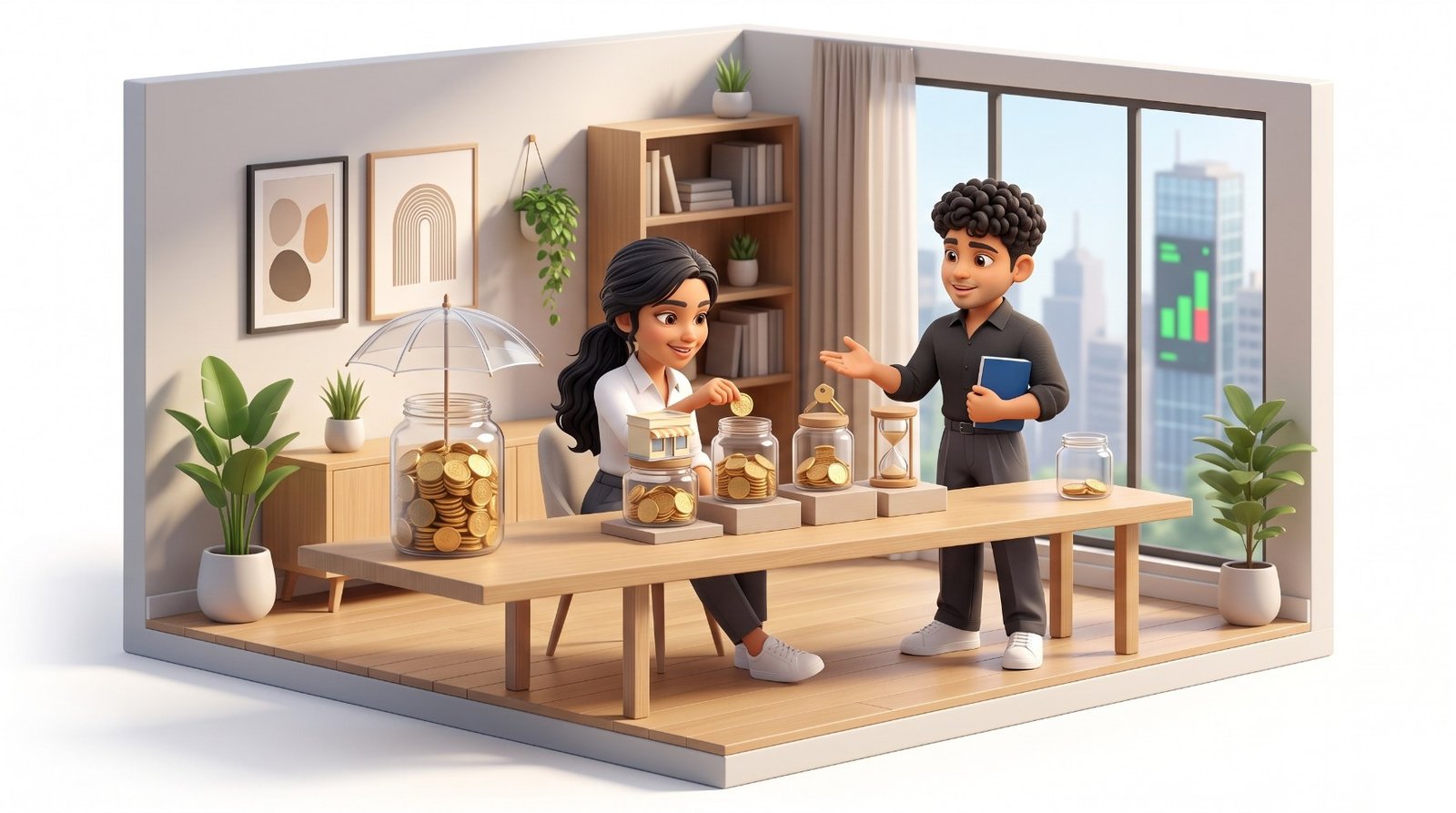
Before you start investing, build a base: an emergency fund of three to six months of essential costs, health cover, life cover if anyone depends on your income, and no costly debt. Then give every rupee a job and every goal a date. Put only money no plan or person depends on into a single share or a first trade.
The base comes first, but cash alone is not the answer either. In September 2026, prices in India were 5.54% higher than a year before, while HDFC Bank and SBI paid 2.50% a year on savings. Money left in a savings account all year bought about 3% less.
By the end you will be able to answer three questions: what has to be in place before you invest a single rupee; why money in a savings account quietly loses, and how invested money grows; and which of your money can take a bet, and which must not.
This lesson follows Maya, who runs a burger restaurant and is learning to invest, as she gets her money ready, with Mr. Chartist as her guide. Maya, her restaurant and her numbers are made up; every rate, price and date beside her is real and dated, and our own sums say "derived". Amounts are in Indian rupees (₹): one lakh is 100000 and one crore is 10 million. The lesson before this one, what moves share prices, showed why prices swing; this one gets your money ready before any of it meets them.
Saving, Investing and Speculating
Three jobs for the same rupee
Two busy years have rebuilt Maya's savings: ₹10 lakh now sits in her bank account, outside the restaurant. She wants it to grow, and she has heard very different things about the share market.

A regular told me the share market is just gambling. Is he right?
It can be. It depends on what you are counting on to pay you.
My restaurant pays me when people buy burgers. Is that what you mean?
Yes. Money in something that earns, for years, is investing. A bet pays only if a price moves your way, soon.
So my restaurant is already an investment, and the ₹10 lakh in my bank is…?
Saving: kept ready for when you need it. Three different jobs for the same rupee.

Saving is money set aside where you can reach it quickly and its rupee value does not swing, such as a savings account. Its return is small and known: the bank sets the rate and can change it. and each paid 2.50% a year in October 2026, and HDFC Bank cut its rate more than once in 2025, the last time to 2.50% from 24 June. Saving's job is to be there, not to grow much.
Investing is putting money into something that produces value over years: a piece of a business, which earns from its customers, or a loan to a borrower, who pays interest. Its value can fall on the way; it needs time.
Speculating is buying mainly to sell soon at a higher price. The thing may earn nothing in that time; the return depends on the price moving your way and on someone paying more. It can lose most of the money, which is why it belongs only to risk money: money no plan and no person depends on (chapter 8).
One share can be either. Held for years for its business, it is an investment; bought only because you hope it will be higher by Friday, it is a bet (trading against investing).
The pattern behind the three: the more a return can swing, the more it may earn over the years and the more it can lose on the way. The US Securities and Exchange Commission (SEC), America's market regulator, puts it as "". Nobody is paid extra for taking no risk, which is why a high return offered with no chance of a loss is a warning sign (how to stay safe).
Figure 1Three jobs
Three jobs for the same rupee
Saving
 2.50% a yearkept ready in a savings account
Rising prices eat it (chapter 3): the balance never falls, but each rupee buys less.
What pays youA rate the bank sets, and can change
Investing
 a piece of a business, paid by its customers
It can fall on the way, sometimes for years; it needs time to come through.
What pays youWhat the business earns, or a borrower's interest
Speculating
 sell by Friday?one share, bought to sell soon
It can lose most of the money, which is why it belongs only to risk money (chapter 8).
What pays youA later buyer paying more
The more a return can swing, the more it may earn over the years, and the more it can lose on the way.
So which job comes first for my ₹10 lakh?
First the Base: Emergency Fund, Insurance, Costly Debt
What has to be in place before you start investing



If I ever need cash, I'll just sell some shares. Isn't that enough?
On the day you need it, the price may be low. A need for cash never waits for a good price.
Then what do I set up before I buy anything?
A base: money for bad months, cover for big bills, and no costly debt.

Selling shares is a poor emergency plan, because the day you need cash may be a day of low prices. In the last lesson's what-if, the investor who needed cash by the next day took the one offer he had, ₹1.3 lakh, for a piece that fetched ₹1.5 lakh on a calmer night. The base is money whose only job is to be there, so nothing else has to be sold on a bad day. Keep two pots, not one: a business needs its own reserve for repairs and slow weeks, and the household base is Maya's personal money, never money the restaurant needs and never a loan.
An emergency fund is money set aside for the unplanned: a lost or halved income, an illness, a big repair at home. The common advice is of essential costs. India's National Institute of Securities Markets (NISM), set up by the Securities and Exchange Board of India (SEBI), gives that range, and the SEC notes that some people keep up to six months of their income; keep more when your income is irregular or others depend on you. To size it, add up one month's essentials (rent or loan payments, food, bills, insurance premiums, school fees, the people you support) and pick the months. Keep it where you can reach it within a day or two and where its value does not move with the market: a savings account, or a fixed deposit (money left with a bank for a set time) that can be broken early. Never in shares: the test is how quickly you can reach it and whether its value holds, not a high return.
Maya's essentials come to ₹45000 a month. Her pay rises and falls with the restaurant, and NISM counts a business's closure as an emergency for the self-employed, so she takes six months, the top of the usual range: ₹2.7 lakh.
Insurance works the other way round. You pay a small, known amount each year, the , so that a rare, large cost falls on an insurer instead of on your savings. Health cover pays hospital bills; life cover pays the people who depend on your income if you die. Maya takes health cover for herself and her mother, so that one hospital bill cannot empty the rest of her savings, and life cover because her mother depends on her. Judge cover by what it pays when things go wrong, not by what it pays back.
Costly debt is debt that costs more than any return you could reasonably expect. The common one is an unpaid credit-card balance: on many HDFC Bank cards it costs 3.75% a month, which the bank's key fact statement (KFS), the one-page summary of a card's charges, states as , before goods and services tax (GST). A card's interest-free days are the weeks between a purchase and the bill's due date; while last month's bill is unpaid, new purchases lose them and interest runs from the day of each purchase. Left unpaid for a year at that rate, ₹10000 costs at least ₹4500, with GST on top; the same ₹10000 in savings earns ₹250. The SEC puts it plainly: "There is no investment strategy anywhere that pays off as well as" paying off high-interest debt. Maya has none: she chose an investor over a loan when she opened (why the stock market exists).
None of this is idle money. The base is what lets the rest of her money stay invested through a bad week.
Figure 2The base
Maya's base, before anything else
Rent, food, bills, insurance premiums and the people she supports.
Rent, food, bills, insurance premiums and the people she supports.
Rent, food, bills, insurance premiums and the people she supports.
Rent, food, bills, insurance premiums and the people she supports.
Rent, food, bills, insurance premiums and the people she supports.
Rent, food, bills, insurance premiums and the people she supports.
₹10000 for one year
An unpaid card balance45% a year, before GST
In savings2.50% a year
Maya's ₹10 lakh, so far
₹2.7 lakhset aside as her base
₹7.3 lakhnot yet given a job
But if ₹2.7 lakh just sits in the bank, isn't it losing value?
Inflation: Why Cash Quietly Loses
Your balance never falls; what it buys does



Prices keep rising. At least my savings sit untouched in the bank.
Untouched? Has that balance ever gone down?
Never. Interest comes in every quarter.
So you never lose a rupee. But each rupee buys a little less: its buying power shrinks.
How much less?
In September 2026, prices were 5.54% higher than a year before. Your savings paid 2.50%.

Inflation is the general rise in prices. A consumer price index (CPI) measures it every month: the price of a fixed basket of what households buy, from food and rent to transport and restaurant meals. India's comes from the National Statistics Office; the US one from the Bureau of Labor Statistics.
Prices do not all rise alike. In the year to September 2026, food in India was up 7.74%, and 9.36%. Your own inflation depends on what you buy; Maya already passes her rising costs into her menu prices, and now sees the same thing in her bank.
Central banks aim for a little. The Reserve Bank of India (RBI), India's central bank, targets 4% a year within a band of 2% to 6%, renewed for April 2026 to March 2031. Even at 4%, prices double in about 18 years. Spikes happen: 7.79% in India in April 2022, and 9.1% in the US in June 2022, its highest since .
Real return is what is left after prices: (1 + return) ÷ (1 + inflation) − 1, roughly the return minus inflation. Take Maya's ₹10 lakh for one year: at 2.50% it earns ₹25000, but with prices 5.54% higher, her ₹10.25 lakh buys what about ₹9.71 lakh bought a year earlier. About ₹29000 of buying power is gone: a real return of . Her base accepts this cost, because its job is to be there. The rest needs to earn more than prices rise, which means owning or lending to things that earn, for years.
Over seven years the loss adds up. Measured: what cost ₹500 in 2017-18 cost about ₹713 by 2024-25, prices 43% higher. Before you look at the figure, work it out: what does a ₹500 note kept in a drawer since 2017-18 buy now? About ₹350 of 2017-18's shopping (₹500 ÷ 1.43, derived). The years start with 2017-18, the first full year of today's stone-grey ₹500 note (it first circulated in November 2016), and stop at 2024-25, because India's CPI moved to a new base in January 2026.
Figure 3Inflation
The note never changes. What it buys does.
The same ₹500 note, every yearwhat it buys at 2017-18's prices
The same shopping, growing to keep up
The start: ₹500 buys ₹500 of that year's shopping.
Prices up 3.41% that year. The note buys ₹484 of 2017-18 shopping.
Prices up 4.80% that year. The note buys ₹461 of 2017-18 shopping.
Prices up 6.15% that year. The note buys ₹435 of 2017-18 shopping.
Prices up 5.47% that year. The note buys ₹412 of 2017-18 shopping.
Prices up 6.65% that year. The note buys ₹386 of 2017-18 shopping.
Prices up 5.38% that year. The note buys ₹367 of 2017-18 shopping.
Prices up 4.62% that year. The note buys ₹350 of 2017-18 shopping.
 ₹713₹5002024-2524-252024-25 · the same shopping
What cost ₹500 in 2017-18 cost about ₹713: prices 43% higher. ₹713 = ₹500 + ₹200 + ₹10 + ₹2 + ₹1.
Maya's ₹10 lakh, so far
₹2.7 lakhthe base: it accepts a small loss to prices as the cost of being ready
₹7.3 lakhearning 2.50% a year while prices rise faster
Then how does money get ahead of prices?
Compounding
Returns that earn returns

If I invest ₹1 lakh at 8%, does it just grow by ₹8000 every year?
Only if you take the returns out. Left in, the returns earn returns too.
Like profit I put back into the kitchen?
Exactly. And the last years add the most, so time does the heavy lifting.

Simple returns pay only on the starting money: ₹1 lakh at 8% a year earns ₹8000 every year. Compounding pays on everything built up: the second year earns 8% on ₹1.08 lakh, the third on ₹1.1664 lakh, and so on. Maya knows it from her kitchen: profit put back into the restaurant earns next year's profit on a bigger kitchen. The comparison stops there: a kitchen can fail, and no rate is fixed.
Worked through, as an illustration and not a forecast: at 8% a year, ₹1 lakh becomes about ₹2 lakh in 9 years, ₹4 lakh in 18 and ₹8 lakh in 27. The first nine years add ₹1 lakh; the third nine add ₹4 lakh. At 27 years it is ₹1 lakh of her own, ₹2.16 lakh of plain returns and ₹4.83 lakh of returns on returns. Slide the years in the figure below and watch which layer grows fastest.
The gives the doubling time roughly: divide 72 by the yearly rate. At 8%, 9 years. Savings at 2.5%: about 29 (the exact answer is 28). And 72 ÷ 4 = 18: the doubling of prices at the RBI's target in chapter 3.
One real line shows the same arithmetic. The Nifty 50 is an index: one number that follows the share prices of 50 large companies on the National Stock Exchange of India (NSE) (how an index is built). It started at 1000 on 3 November 1995 and closed at 22620.45 on 30 September 2026: 22.6 times in about 31 years, which is . Had the same 10.61% been earned each year only on the first 1000, the index would have reached about 4280. The rest of the rise, about 18340 points or 85% of it, is growth on growth. That is the price alone, before dividends (the cash some companies pay their owners, chapter 5), and the line was never smooth: it fell hard more than once (how long those falls lasted). It measures the past; it forecasts nothing.
Figure 4Compounding
₹1 lakh, left to grow
At 8% a year, after 27 years₹7.99 lakh₹1 lakh of hers, ₹2.16 lakh of plain returns and ₹4.83 lakh of returns on returns: ₹7.99 lakh after 27 years
Figure 5Compounding
The same arithmetic on a real line
The Nifty 50, 3 Nov 1995 to 30 Sep 202622.6 timesin about 31 years: 10.61% a year
Growth on growth: about 85% of the rise
Straight line: the same 10.61% a year, paid only on the first 1000. Hover or tap the line for any month's close.
No rate is promised. 8% is a teaching number; no investment promises it, and shares can move far more than that in a single year: the same index fell 8.09% in the year to 30 September 2026 (chapter 5). Three things break compounding: taking the returns out; a large loss, since a 50% fall needs a 100% rise to recover (risk management); and costs. It works against you too: prices compound (chapter 3), and so does unpaid debt. For Maya, retirement is about 28 years away; time is the one thing she cannot add later.
But who actually pays these returns?
Where Returns Come From
Every return has a payer



My savings pay 2.50%. Where does that money actually come from?
From a borrower. Every return has a payer: find out who it is.
And if nobody can tell me who pays?
Then be careful. A return with no payer is a warning sign.

Interest: a deposit is a loan to the bank; the bank lends it on at a , and the borrower's interest pays yours. It is known in advance; the risk is that whoever borrowed your money cannot pay it back: the bank, for a deposit, or a company, for a bond, a loan you make to a company or a government. In FY26, India's financial year from April 2025 to March 2026, took in about ₹4.8 lakh crore of interest from the people, firms and governments it lends to, and paid out about ₹3.1 lakh crore to its depositors and others it borrows from: about ₹64 of every ₹100 went straight out again. The rest, with its fees and other income, paid its staff and running costs, covered loans that went bad, paid its tax and left its profit. Maya's 2.50% at HDFC Bank is paid the same way: by somebody's interest on a loan.
Profit: a share is a piece of a business, and what is left after costs is profit. Owning a share funds someone else's griddle, and that business's customers are the payer. Owners are paid two ways: a dividend, cash paid out of profit, and a piece that can be worth more when profits grow, or less. Neither is known in advance.
Price only: some things earn nothing while you hold them, such as gold, a painting or a collectible. The only return is a later buyer paying more. And a contract between two traders, a future or an option (a contract on a price at a later date), earns nothing by itself: one side's gain is the other side's loss, before costs.
A real year, in shares: in the year to 30 September 2026, the Nifty 50's price, what buyers would pay, fell 8.09%; with dividends counted, owners' return was −7.09%, so dividends added about one point. In one year the price swamps the dividend; what moves the price is the last lesson's subject.
Figure 6Who pays
Follow the rupee back: every return has a payer
 Borrowerspeople, firms and governments
Interestthrough the bank
reaches youInterest on your deposit, or on a bondOne real bank's year, SBI, FY26
Interest in from borrowers about ₹4.8 lakh crore; paid out to savers and lenders about ₹3.1 lakh crore: ₹64 of every ₹100 went straight out again.
 Customersof a business
Profits and pricewhat is left after costs
reaches youA dividend, and a piece worth more, or lessOne real year, the Nifty 50 to 30 Sep 2026
Price −8.09%; dividends added about one point; with dividends counted, −7.09%. Neither was known in advance.
 A later buyerof gold, a painting
Price onlyit earns nothing meanwhile
reaches youA higher price, or a lower one
Not known The trader on the other sideof a future or an option
The other side's lossbefore costs
reaches youA gain only if they lose
Not knownThe check: before believing any return, ask who pays it. If the answer is "the next people who join", or nobody can say, that is a warning sign (how to stay safe).
Then how do I compare two returns fairly?
Measuring a Return
How far, and how fast
My first investor made 50% on his piece of the restaurant. Is that good?
Over how long? 50% in two years and 50% in ten are very different.
Like saying I drove 100 kilometres, without saying in how many hours?
Exactly. Turn it into a per-year rate before you compare it.

Maya wants to compare two returns fairly, and she starts in the right place: a return without its period is a distance without a time. The comparison stops in one place: money's speed compounds, a car's does not.
The return over the whole period is (what you got back − what you put in) ÷ what you put in. Maya's first investor paid ₹1 lakh for his piece of her restaurant and sold it two years later for ₹1.5 lakh: (₹1.5 lakh − ₹1 lakh) ÷ ₹1 lakh = +50%.
The per-year return, compounded, is called , the compound annual growth rate: the steady yearly rate that turns the start into the end over the same years. Guess his per-year rate before reading on. It is not 25%: his 50% over 2 years is 22.5% a year, because the second year earns on the first year's gain too. The same 50% over 10 years is 4.1% a year, barely above the RBI's 4% target and below September 2026's 5.54%. It is not 50 ÷ 10: the years compound (chapter 4). NSE's own index factsheet says the same: "Returns for greater than one year are CAGR returns".
A real return, read the same way: the Nifty 50 closed at 17618.15 on 30 September 2021 and at 22620.45 on 30 September 2026, 28.4% in all over five years. Divided by five, that looks like 5.68% a year; compounded, it is , the figure NSE's factsheet prints. Never divide a whole-period return by the years. It is also price only, before dividends (how much they add).
Then take off prices (chapter 3), and costs and tax (brokerage, charges and taxes). Four questions fit any return: Over how long? For the whole period, or per year? Before or after prices? Before or after costs and tax?
Figure 7Per year
The same 50%, two speeds
Read a return per year: the slope is the speed.
Figure 8Per year
How far, and how fast: the Nifty 50
100 grows 5.13% each year, one step at a time
- Over how long?5 yearsOver how long? 5 years
- For the whole period, or per year?28.4% in all; 5.13% a yearFor the whole period, or per year? 28.4% in all; 5.13% a year
- Before or after prices?Before: set it beside prices over the same yearsBefore or after prices? Before: set it beside prices over the same years
- Before or after costs and tax?Before: an index has no costs; a fund that copies it has some, and gains are taxedBefore or after costs and tax? Before: an index has no costs; a fund that copies it has some, and gains are taxed
So what does my money need to do, and by when?
Goals and Deadlines
What, how much, by when
On her way back from buying supplies, Maya passes an empty shop on a busy corner, with a glass front and room for a second kitchen. She stands there longer than she means to.

I'd love a second outlet one day. Is that a goal?
Not yet. A goal needs three things: what, how much and by when.
A second outlet, in about three years. And how much?
Price it at that date, not today's. Costs keep rising until then.

A goal has three parts: what, how much, by when. "A comfortable retirement" is a wish until it has an amount and a date.
Price it at its date, because costs rise until then (chapter 3). Maya's goals are made up, with costs grown at an assumed 6% a year, the top of the RBI's band; a goal's own costs can rise faster or slower, and restaurant prices rose 9.36% in the year to September 2026. A second outlet in about 3 years, ₹10 lakh at today's prices by her own estimate, becomes about . A home in about 10 years, with a ₹20 lakh down payment today, becomes about ₹35.8 lakh. Retirement at about 60, some 28 years away, is the far goal; its amount is worked out later.
Most goals are reached by adding money from income, month by month, not by one sum: her goals come to about against the ₹7.3 lakh not yet given a job. So write each goal on one line: what, how much today, how much then, by when, set aside so far, added each month. How to add money steadily (monthly investing in funds) and how to split it come in later lessons.
The date decides how much risk the money can take. You have met the Nifty 50 three times in this lesson: 10.61% a year since November 1995 (chapter 4), −8.09% over the past year (chapter 5) and 5.13% a year over the past five (chapter 6). All three were read on the same day, 30 September 2026, and all three are true: price only, past windows, not a forecast. Which one a goal lives through depends only on how long it has. Money with a near date lives inside a short window, and a short window can be a bad one; money with a far date spans many. The SEC draws its line at five years: for a goal "five years or less, you don't want to choose risky investments".
Sort every rupee by its date: the base (any day), the outlet (3 years), the home (10), retirement (28). Asset allocation basics shows how long real falls lasted and matches each goal to what it can hold.
Figure 9Goals
Maya's goals on one ruler of years
- The base₹2.7 lakh→ any daynowThe base · ₹2.7 lakh · any day · now
Six months of essentials, set aside now; kept within reach, out of the market. 
 A second outlet₹10 lakh today→ about ₹11.9 lakh thenin about 3 yearsA second outlet · ₹10 lakh today · about ₹11.9 lakh then · in about 3 years
₹10 lakh at today's prices, her own estimate; × 1.06³ ≈ ₹11.9 lakh. Set aside so far and added each month: from her income, split in a later lesson. A home₹20 lakh down today→ about ₹35.8 lakh thenin about 10 yearsA home · ₹20 lakh down today · about ₹35.8 lakh then · in about 10 years
A ₹20 lakh down payment at today's prices; × 1.06¹⁰ ≈ ₹35.8 lakh. Added each month from her income.- Retirementto be sized→ at about 60in about 28 yearsRetirement · to be sized · at about 60 · in about 28 years
The far goal: its amount is worked out later. Decades of time, the one thing she cannot add later.
Tap a band for what the Nifty 50 did over a window that long.
The Nifty 50's last year, to 30 Sep 2026: price −8.09% (chapter 5).middlePast the SEC's five-year line
The Nifty 50's last five years, to 30 Sep 2026: 5.13% a year (chapter 6).farA far date spans many windows
The Nifty 50 since Nov 1995, about 31 years: 10.61% a year (chapter 4).
years from today
Maya's ₹10 lakh, so far
₹2.7 lakhthe base, for any day
₹7.3 lakhnow dated: the outlet in 3 years, the home in 10; retirement waits for its amount
And whatever has no date at all?
Risk Money
Not your goal money: the money for a single bet

After my base and my goals, a little is left. Can that go into one share I like?
Only if no plan and no person depends on it. That is risk money.
And my retirement money? It rises and falls too.
It does, but it is spread wide and has a date. Risk money takes the single bets.

Risk money is money you could lose all of without changing your plans, your sleep, or the care of anyone who depends on you.
: no plan waits for it, so it is not the base and not a goal, and no date depends on it; a fall to half, or to nothing, would change nothing important; and you would never borrow to replace it.
It is not the same as long-term money. Maya's retirement money may sit through falls for decades, but it is spread wide and has a date; a single share she is learning on could fall to almost nothing. If a fall on paper would make you sell, the plan is too bold for you (risk that fits your nerves).
What it is for: learning to pick single shares, a first trade, a new kind of asset, the things that can go badly while you learn. What it is never: the emergency fund, money with a goal's date, borrowed money, or "spare this month" that next month's bills will need.
Name it before you use it. Maya names hers, her : a small part of what is left after her base and goals. Asset allocation basics sizes it, and risk management shows how much of it one trade may risk.
Before the first rupee meets the market, run six checks, each from a chapter of this lesson. Three to six months of essentials set aside, within reach? Health covered, and life too if anyone depends on your income? No costly debt, such as an unpaid card balance? Can you say who would pay the return you hope for? Does every rupee have a job, and every goal a date? Is the money for any single bet money that no plan or person depends on? Six yeses: ready to start. Any no: fix that first.
Figure 10Ready?
Am I ready to invest?
Maya's ₹10 lakh, so farNext: what each rupee can buy
₹2.7 lakhthe base, set
₹7.3 lakhgoals dated; risk money named, and sized later from this part
Putting the pieces together: the base comes first, so no shock can force you to sell. Cash in a savings account loses to prices while invested money grows on itself, paid by borrowers and businesses and never promised, so read every return per year and ask who pays it. Goal money is matched to its date, and only risk money takes a single bet.
Base first, every goal dated, and only risk money on a single bet. Now you're ready.
Then, besides shares, what can my savings actually buy?
Before you go
Check yourself
4 questions from this lesson. Pick an answer to see why, then slide on to the next.
Question 1 of 4
Questions readers ask
Common questions
What should I do before I start investing?
Build a base first: an emergency fund of three to six months of essential costs, health cover (and life cover if anyone depends on your income), and no costly debt. Then give each goal an amount and a date. Put only money no plan or person depends on into a single share or a first trade.
How much emergency fund do I need before investing?
The common advice is three to six months of essential costs, kept within easy reach and out of the market; more if your income is irregular or others depend on you. Six months of ₹45000 essentials is ₹2.7 lakh.
Should I pay off debt before investing?
Clear costly debt first. On many HDFC Bank cards an unpaid balance costs 3.75% a month, which the bank states as 45% a year, before GST; no investment can be counted on to earn that, so the card comes first.
What is the difference between saving and investing?
Saving keeps money ready for a small, known return. Investing puts money to work for years in something that earns, a business or a borrower, and its value can fall along the way.
How does inflation affect my savings?
The balance never falls, but each rupee buys less. In September 2026, prices in India were 5.54% higher than a year before while HDFC Bank and SBI paid 2.50% on savings, so money left there lost about 2.9% of its buying power.
What is the rule of 72?
Divide 72 by a yearly rate to find roughly how many years it takes to double: at 8%, about 9 years; at 4% inflation, prices double in about 18.
Words to keep
The 14 words this lesson used, in plain English
Saving
Setting money aside where you can reach it quickly and its rupee value does not swing, for a small, known return.